

As an author, I couldn’t be happier and more satisfied with the experience at the Pax Lúdica event in Cádiz. Many people gathered to learn about the game, eager to have the mechanics explained, and we hosted games every day throughout the event.
“Rebellion and Punishment: The War of the Alpujarras” is a historical simulation game featuring a card-driven engine that recreates the events of the rebellion led by the Moriscos, the descendants of the former Muslim inhabitants of the Nasrid kingdom of Granada, against the Catholic Monarchs’ attempt to impose complete cultural assimilation under Philip II.
The Moriscos planned to revolt on January 1, 1569, coinciding with the anniversary of the Christian troops’ first entry into Granada. They intended to present themselves in the city with 8,000 warriors disguised as Turks to set ablaze the Albaicín district, where the Morisco population resided within the city’s walls.
However, the uprising erupted spontaneously and uncontrollably by the rebel leaders during Christmas of 1568, leading to the failed attempt to seize Albaicín. Granada remained safe, but various towns in the Alpujarras rose up, marking the beginning of a brutal and relentless war that put the Hispanic monarchy of Philip II on the brink. Fernando de Valor, a descendant of the ancient Umayyad dynasty that once ruled the Caliphate of Córdoba, proclaimed himself king of the Moriscos as Aben Humeya.
At that moment, the game began, with several towns in the Alpujarras revolting after the failed coup attempt in Granada, and the leaders and rebel forces quickly spreading the rebellion throughout all the towns they encountered.
The number of soldiers available from the royal army was very limited; most of the quality troops were in Flanders fighting against the Protestant Orangists or in Italy, holding back the Turks. The only forces at hand consisted of local militias, some veteran soldiers from the tercio close to retirement, tasked with garrisoning coastal defenses against incursions from North African pirates, and little else.
While the Morisco troops are comprised of Monfíes, guerrillas who have spent decades practicing banditry and resisting Castilian forces, the Gandules, ancient municipal militias of the Kingdom of Granada, organized by neighborhoods around mosques, will soon be joined by Berbers from North Africa sent by Ali Pasha. These Mujahideen will come to fight for the defense of Islam, accompanied by expert military advisors and elite troops of Janissaries dispatched by the Turkish Sultan.
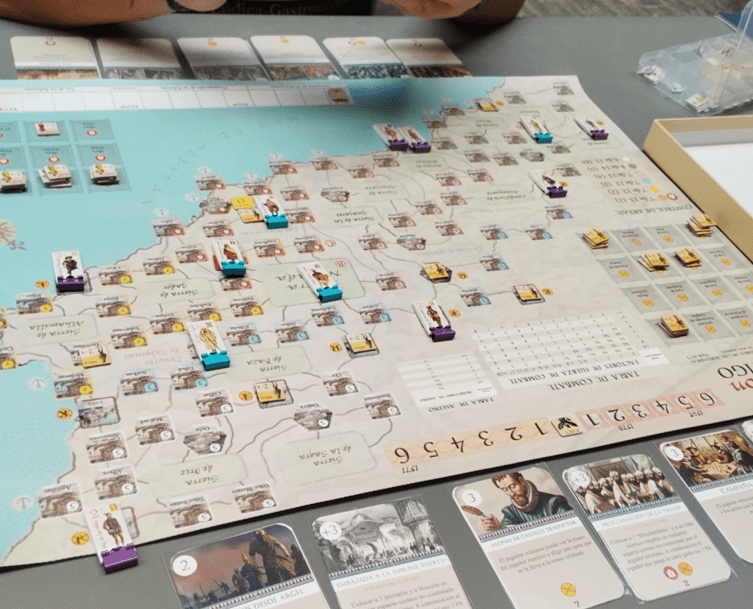
Aben Humeya emerges with his troops in Juviles, while Aben Aboo lays siege with his forces to a small garrison that has managed to barricade itself in the tower of Órgiva. Aben Farax, the most combative leader at the forefront of the feared Monfíes, waiting for his opportunity in the Sierra Nevada after hastily retreating from Granada. El Galipe leads the uprising in Malaga and El Gorri in Almería, in the Andarax valley.
In this initial phase of the war, known as “The Marquises’ Campaign,” the repression of this uprising is handled by two nobles embroiled in long-standing family feuds stemming from the Castilian civil war between the Beltranajosos and the Isabelinos. On one side is the Marquis of Mondejar, General Captain of Granada and a member of the Mendoza family, who holds a more negotiable and conciliatory approach. On the other side is the Marquis of Los Velez, from the Fajardo family, who receives a letter from Philip II instructing him to prevent the spread of the rebellion to Eastern Spain from Murcia, and to suppress the attempts at rebellion in neighboring Almería as best he can.
Each player draws seven cards from the unique game deck and plays six impulses, with the option to keep one card for the next turn; if they do, they will only draw six cards this time.
During the first turn, set during the Christmas of 1568, the Morisco player has the initiative and plays first. Their opening card is a mandatory initial event: the coronation of Aben Humeya as king of the Moriscos, followed by the use of action points. With these points, the Morisco player can activate their leaders, spending activation points equal to their leader’s strategic capacity. Leaders have three strategic capacities: 1, 2, and 3. The lower the value, the better the leader, requiring fewer action points to activate.
At the game’s start, most populations are not in rebellion; only seven villages in the Alpujarras, one in Málaga, and another in Almería in the Andarax valley are. The rest, in theory, remain loyal to the crown, with the population torn between the desire for rebellion, fear of repression, and some truly loyal subjects who wish to remain uninvolved in the uprising.
When the rebel troops entered a village, they gathered the inhabitants in the plaza, burned churches, and ruthlessly pursued old Christians and the religious, compelling the population to join them. Many willingly joined, but others had no choice but to comply.
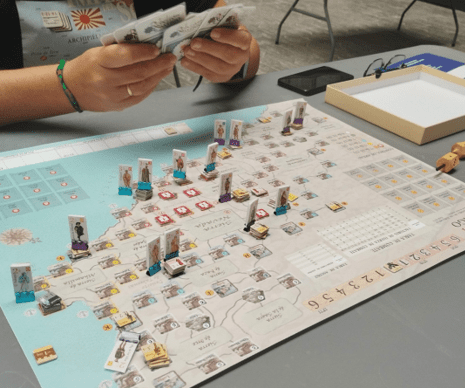
In the game, when a Moorish troop enters a settlement, it spends an additional movement point to incite an uprising and join the rebellion. Conversely, when a royal troop enters a rebel settlement, it also expends an extra movement point to quell the uprising. If troops from both sides are present in a settlement, an armed confrontation occurs; the victor of this battle automatically gains control of the settlement.
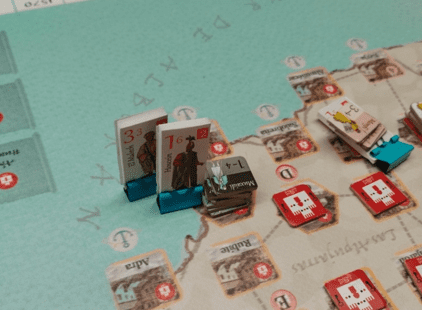
Soon, the long-awaited North African and Turkish aid arrives on the shores, consisting of mujahideen summoned to defend the Islamic faith and Janissaries led by the Turkish captain Hosein.
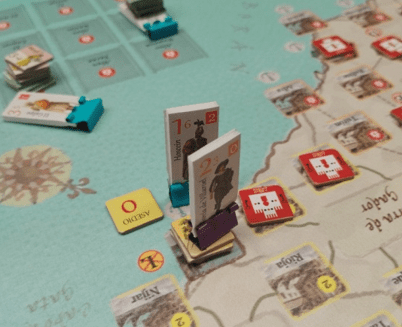
The city of Almería is soon besieged, with its garrison under the command of García de Villarroel desperately calling for aid from both the Marquis of Mondejar and the Marquis of Vélez.
During the initial phases, the Moorish rebellion spreads rapidly, successfully laying siege to and capturing significant cities such as Málaga and Almería. Consequently, the Victory Points quickly shift in favor of the insurgents.

Aben Aboo and El Galipe await from within the walls of the city of Málaga, recently taken by the Moriscos, for the arrival of Antonio de Luna and his troops. Meanwhile, Aben Humeya is stationed in Alfarnate.
At the end of each turn, there is a rebellion expansion phase where the Morisco player rolls a die. This determines a population within the region rolled at random, where they can spontaneously deploy a troop of gandules.

Two of the most charismatic and well-known Christian leaders, both with extensive military experience, arrive in the conflict zone: Luis de Recasenz and Álvaro de Bazán, accompanied by seasoned tercio units from Italy.
At the start of each turn, a die is rolled to determine which player has the initiative and plays their cards first. The player who did not have the initiative in the previous turn receives a +1 bonus to their die roll for this determination.
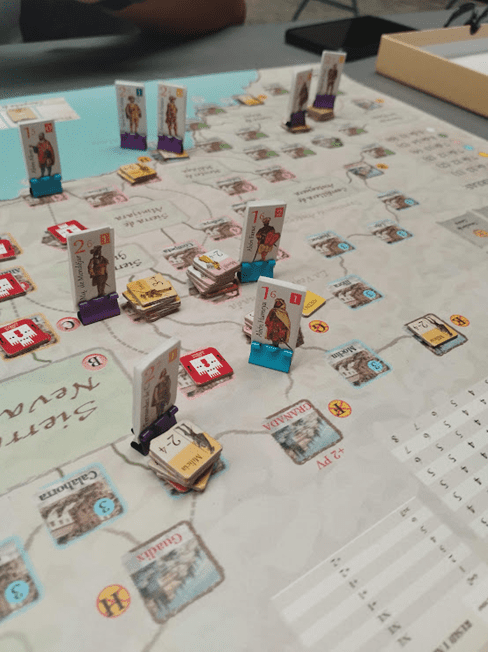
Ultimately, to summarize, the games played during the Pax Lúdicas featured numerous remarkable circumstances, some epic in nature, such as Aben Humeya’s attempted siege of Granada, taking advantage of the Marqués de Mondejar’s army being engaged in the Alpujarras, or the glorious defense of Lorca by the Marqués de Mondejar, who, without any troops—only the garrison—staunchly resisted Aben Farax’s assaults until the latter was forced to retreat with the arrival of Christian reinforcements, failing to capture the Murcian city. There was also the Conquest of Málaga by Aben Aboo. The players thoroughly enjoyed these scenarios, and I relished teaching them. I look forward to sharing ongoing developments in the game’s progress, along with the upcoming testing sessions.
My heartfelt thanks to Pedro Mayorga, Manuel Sancho, Raúl Nuñez, José Martinez, and José Antonio Polo for dedicating their time during the event to play Rebelión Y Castigo and for their consistently positive and constructive contributions to its enhancement. Special thanks to Francisco Javier from In Ludo Véritas for his support, as well as José Manuel Neva for believing in the development of this game, and to Sergio and his fellow Pax Lúdica members for their tireless efforts organizing the Cádiz event, which benefits all wargaming enthusiasts. A big hug to all!
Fran Mariscal.
 (Probably by the end of this month or begining of April).
 English
  Spanish